Sample cover — replace with client asset
The Harbour Line
From$6.99

Forty pages on editing standards, cover design, ISBNs, royalties and realistic timelines.
Get the guideEvery inclusion, allowance and limit in one table you can filter and print.
Open the comparisonAdd any services to a saved plan and send it to a consultant for a single quote.
Open the services storeBrowse paperbacks, hardcovers, eBooks and audiobooks from writers we have worked with.
Visit the bookstoreBring a question about your manuscript and get an answer from our editorial team.
See upcoming webinarsLine-by-line work on clarity, consistency, rhythm and continuity, delivered as tracked changes you control.
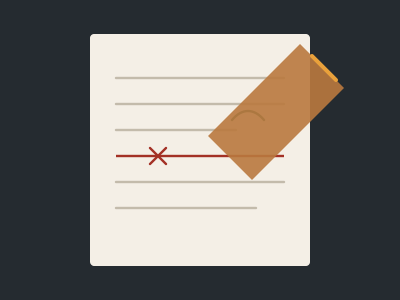
A copyedit is where the writing gets better sentence by sentence.
Your copyeditor works through the manuscript attending to things that are individually small and collectively decisive: sentences that carry two ideas when they should carry one, words repeated three times in a paragraph, a character whose eyes change colour in chapter nine, tense that drifts mid-scene, a dependent clause that makes the reader reread, a fact that contradicts something on page forty. They also enforce consistency in the hundred small decisions a book contains — hyphenation, capitalisation, number style, how you handle dialogue, whether it is grey or gray.
Everything arrives as tracked changes. Nothing is altered silently. Stylistic suggestions come as comments rather than edits, so a deliberate fragment stays a deliberate fragment. You accept and reject change by change, and the ones you reject teach the editor your preferences for the rest of the manuscript.
You also receive a style sheet: the record of every convention applied to your book, including character names, place names, invented terms and your specific stylistic choices. Keep it. If you write a sequel, it saves you a fortune in continuity errors.
Copyediting happens after any structural work and before typesetting. That order is not negotiable, because editing typeset pages costs more and introduces new errors.
Exactly what lands in your inbox, listed the same way it appears in your written scope.
Having these ready before we start is what keeps the timeline honest.
Production timelines are estimates. Actual schedules vary with manuscript length, revision rounds, author response time and third-party retailer processing.
We copyedit 1,000 words as a free sample so you can see the editor's hand before committing.
You confirm your preferred style guide, spelling convention and any house rules of your own.
The editor works through the manuscript, building the style sheet as they go.
You accept, reject or query every change. Comments explain anything non-obvious.
The editor reviews your decisions, catches anything the changes introduced, and delivers the final file.
Sample catalog titles. Replace with a real portfolio of work you have permission to show before launch.
Sample cover — replace with client asset
From$6.99
Sample cover — replace with client asset
From$6.99
Sample cover — replace with client asset
From$9.99
Sample cover — replace with client asset
From$11.99
If you need several services, a package is usually less than buying them individually.
A complete, professional first edition
First-time authors with a finished, self-edited manuscript who want a properly produced paperback and eBook without paying for services they are not ready to use.
Placeholder price. $400 reserves your slot; balance invoiced against milestones.
Yes. We copyedit 1,000 words of your actual manuscript before you commit, so you can see how heavy the editor's hand is and whether the two of you will get along.
A copyeditor flags internal contradictions and anything that looks obviously wrong, but they are not a fact-checker. If your book depends on verifiable claims, add the fact and citation check — it is a separate discipline.
Whichever you prefer. We apply it consistently and record the decision on your style sheet. What matters is consistency, not which side of the Atlantic you chose.
You can, but understand what you are choosing. A proofread catches errors; it does not improve writing. If the prose is genuinely already strong, proofreading alone is defensible. For most first books, it is not.
Editing
Structural work on what the book is doing — plot, argument, order, pacing — before anyone touches a single sentence.
Editing
The final safety net on typeset pages — typos, spacing, bad breaks and layout errors, caught before anything goes to print.
Design
Professional typesetting — the invisible craft that lets a reader forget they are reading a designed object.
Send us the manuscript. If this is not the service that would help your book most, we will tell you which one is.
Your manuscript stays confidential. We claim no rights in your work at any stage.