Sample cover — replace with client asset
The Harbour Line
From$6.99

Forty pages on editing standards, cover design, ISBNs, royalties and realistic timelines.
Get the guideEvery inclusion, allowance and limit in one table you can filter and print.
Open the comparisonAdd any services to a saved plan and send it to a consultant for a single quote.
Open the services storeBrowse paperbacks, hardcovers, eBooks and audiobooks from writers we have worked with.
Visit the bookstoreBring a question about your manuscript and get an answer from our editorial team.
See upcoming webinarsThe final safety net on typeset pages — typos, spacing, bad breaks and layout errors, caught before anything goes to print.
Proofreading is the last thing that happens before a book goes to press, and it is the only stage that looks at the book as an object rather than as a text.
The proofreader works on the typeset pages, not the manuscript. That matters, because typesetting introduces its own errors: a heading orphaned at the foot of a page, a widow line carried alone to the next, a hyphenation break that splits a word absurdly, running heads that still say the previous chapter's title, page numbers that skip, a caption misaligned with its image, an entry in the table of contents pointing at the wrong page.
They also catch what survived the edit. However good a copyedit is, a small number of errors always slip through — the eye reads what it expects. A fresh reader working slowly on paper-like proofs finds them.
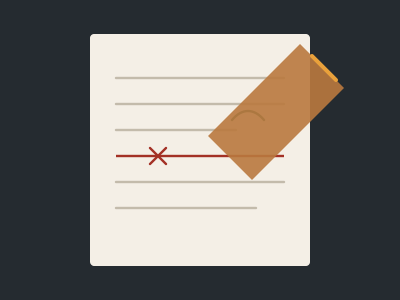
Corrections come back marked on the PDF and are applied by the typesetter, then checked again. Two things are worth being honest about: no proofread catches literally every error in a full-length book, and any changes you make after the proofread need re-checking, because new text introduces new errors.
Exactly what lands in your inbox, listed the same way it appears in your written scope.
Having these ready before we start is what keeps the timeline honest.
Production timelines are estimates. Actual schedules vary with manuscript length, revision rounds, author response time and third-party retailer processing.
Proofreading starts only once the interior is laid out. Proofreading a manuscript is a copyedit by another name.
The proofreader works through the PDF at reading pace, marking text and layout errors together.
Your own corrections are collected at the same time and merged into a single correction list.
The typesetter applies every correction; the proofreader checks each one was made and nothing new broke.
Sample catalog titles. Replace with a real portfolio of work you have permission to show before launch.
Sample cover — replace with client asset
From$6.99
Sample cover — replace with client asset
From$6.99
Sample cover — replace with client asset
From$9.99
Sample cover — replace with client asset
From$11.99
No, and anyone who promises otherwise is overselling. Professionally published books carry a small number of errors too. A good proofread finds the overwhelming majority and, importantly, all the ones a reader would notice.
You can, but every change needs re-checking because new text introduces new errors — and a single added line can reflow an entire chapter. Substantial post-proof changes are quoted as a second pass.
The EPUB is checked separately for conversion-specific issues: broken links, misplaced images, contents navigation and reflow behaviour at different font sizes. That check is included with eBook conversion.
Editing
Line-by-line work on clarity, consistency, rhythm and continuity, delivered as tracked changes you control.
Design
Professional typesetting — the invisible craft that lets a reader forget they are reading a designed object.
Production
Print-on-demand setup and offset print run coordination, with a physical proof before anything is committed.
Send us the manuscript. If this is not the service that would help your book most, we will tell you which one is.
Your manuscript stays confidential. We claim no rights in your work at any stage.