Sample cover — replace with client asset
The Harbour Line
From$6.99

Forty pages on editing standards, cover design, ISBNs, royalties and realistic timelines.
Get the guideEvery inclusion, allowance and limit in one table you can filter and print.
Open the comparisonAdd any services to a saved plan and send it to a consultant for a single quote.
Open the services storeBrowse paperbacks, hardcovers, eBooks and audiobooks from writers we have worked with.
Visit the bookstoreBring a question about your manuscript and get an answer from our editorial team.
See upcoming webinarsStructural work on what the book is doing — plot, argument, order, pacing — before anyone touches a single sentence.
Developmental editing is the only kind of editing that can change what your book is. Everything else changes how it reads.
Your editor works through the whole manuscript looking at architecture. In fiction: whether the story earns its ending, where the middle sags, whether characters want things clearly enough to drive scenes, whether the viewpoint is disciplined, what the reader knows at each point and whether that is deliberate. In nonfiction: whether the chapters are in the order a reader needs rather than the order you learned them, whether each chapter has one job, whether the evidence supports the claims, and where you are explaining something the reader already accepted three pages ago.
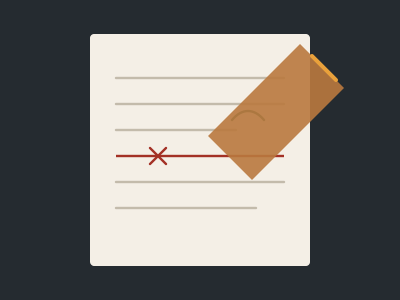
You receive two things. First, an editorial report — typically fifteen to twenty-five pages — that lays out the manuscript's structure, identifies the specific problems in priority order, and proposes concrete solutions rather than describing symptoms. Second, the manuscript itself with margin queries at the exact places where something is going wrong, so the report's abstractions have addresses.
Then you revise. This normally takes authors between one and four months, and that time is not wasted — it is where the book actually improves. Your editor is available for questions throughout, and a follow-up call is included once you have read the report and had time to sit with it.
This is the most demanding service we offer, for you as much as for the editor. It is also the one that most reliably changes how a book is received.
Exactly what lands in your inbox, listed the same way it appears in your written scope.
Having these ready before we start is what keeps the timeline honest.
Production timelines are estimates. Actual schedules vary with manuscript length, revision rounds, author response time and third-party retailer processing.
You tell us what the book is for and what you already suspect is wrong. We match an editor with genuine experience in your form.
The editor reads once for experience, then again for analysis, mapping the manuscript's actual structure against its intended one.
You receive the written report and the queried manuscript together, so every general point has specific examples.
A 60-minute call once you have absorbed the report, to decide what you will act on and what you will leave.
You revise at your own pace with email access to the editor for questions. Most authors take one to four months.
Sample catalog titles. Replace with a real portfolio of work you have permission to show before launch.
Sample cover — replace with client asset
From$6.99
Sample cover — replace with client asset
From$6.99
Sample cover — replace with client asset
From$9.99
Sample cover — replace with client asset
From$11.99
If you need several services, a package is usually less than buying them individually.
A complete, professional first edition
First-time authors with a finished, self-edited manuscript who want a properly produced paperback and eBook without paying for services they are not ready to use.
Placeholder price. $400 reserves your slot; balance invoiced against milestones.
Deeper editorial and a design-led jacket
Authors who want their manuscript genuinely improved before it is produced — a full copyedit, more design exploration, and a hardcover edition alongside the paperback.
Placeholder price. $750 reserves your slot; balance invoiced against milestones.
Per word, because that is what determines the work. The starting rate applies to clean, straightforward manuscripts; dense nonfiction with heavy sourcing or manuscripts needing significant restructuring are quoted higher. You get a fixed price in writing after we have seen the actual file.
No. Developmental editors diagnose and propose; they do not rewrite. Every suggestion is yours to accept, adapt or reject. If you want someone to write with you, that is collaborative writing and a different engagement.
No — and this is the most common expensive mistake in independent publishing. Copyediting polishes sentences. If the developmental edit then cuts three chapters, you paid to polish sentences that no longer exist. Always structure first.
That happens and it is fine. The report is a professional reader's analysis, not a verdict. Bring your disagreements to the consultation call — sometimes the editor missed context, and sometimes the disagreement reveals that the intent is not on the page yet, which is itself useful.
Editing
An honest written verdict on whether your manuscript is ready, and what it needs before you spend money on production.
Editing
Line-by-line work on clarity, consistency, rhythm and continuity, delivered as tracked changes you control.
Editing
The final safety net on typeset pages — typos, spacing, bad breaks and layout errors, caught before anything goes to print.
Send us the manuscript. If this is not the service that would help your book most, we will tell you which one is.
Your manuscript stays confidential. We claim no rights in your work at any stage.